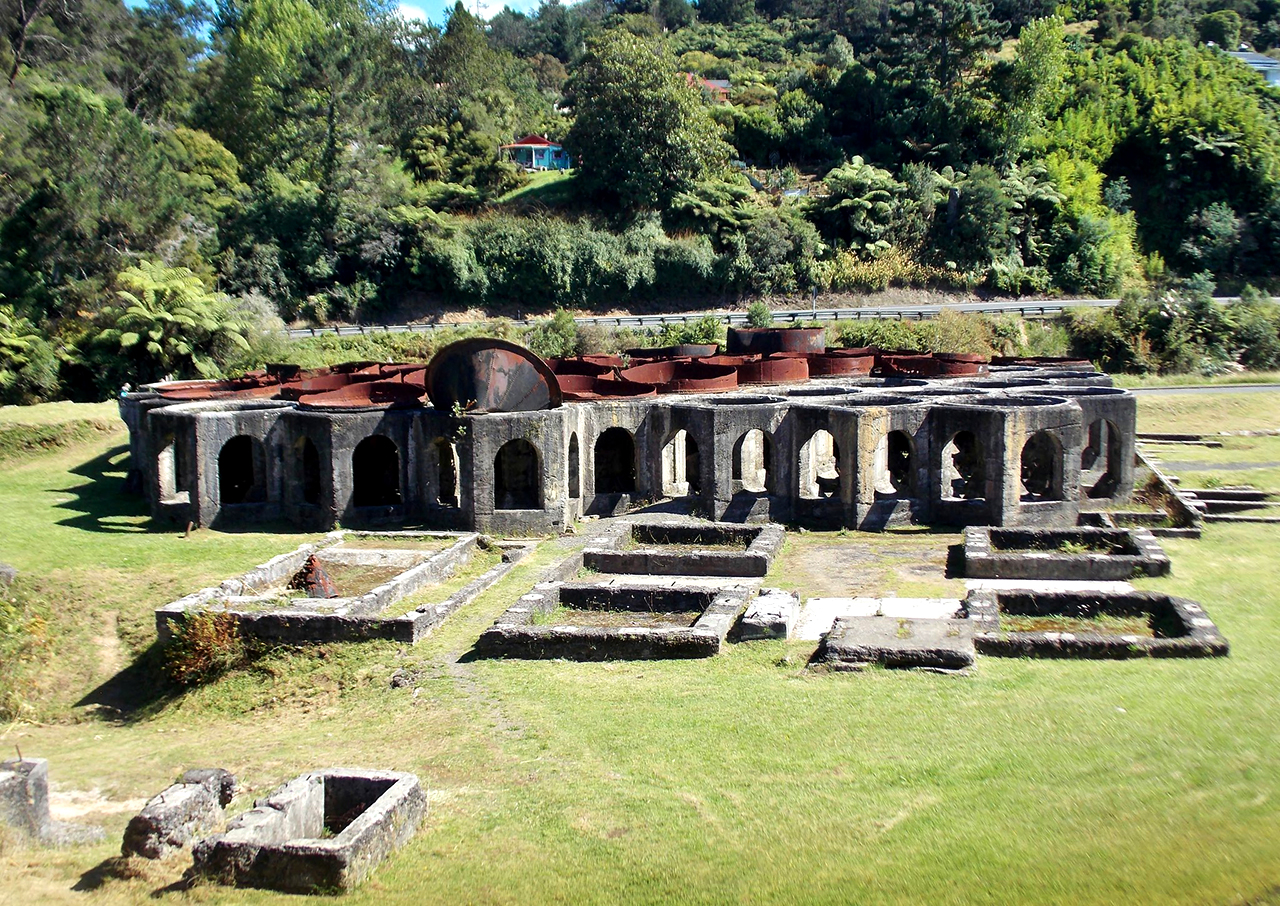
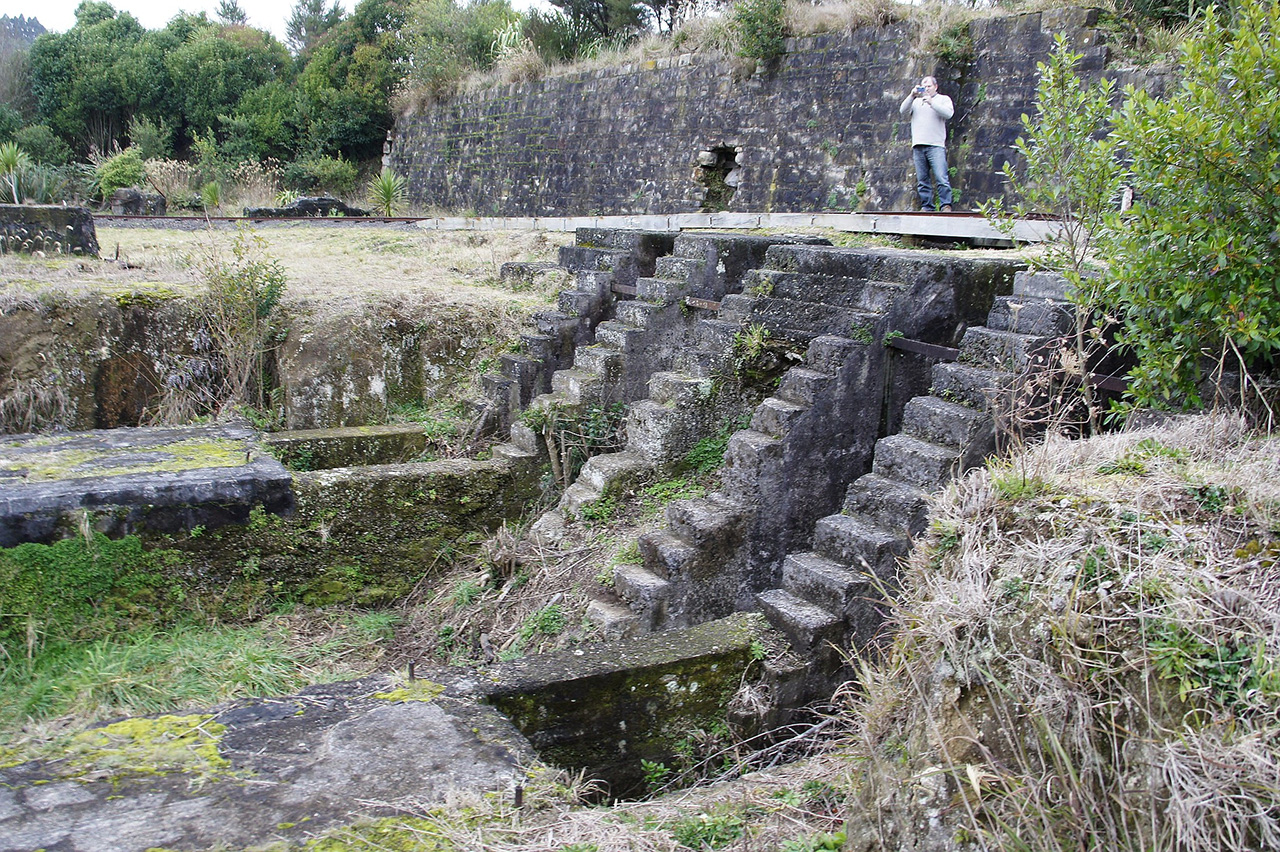
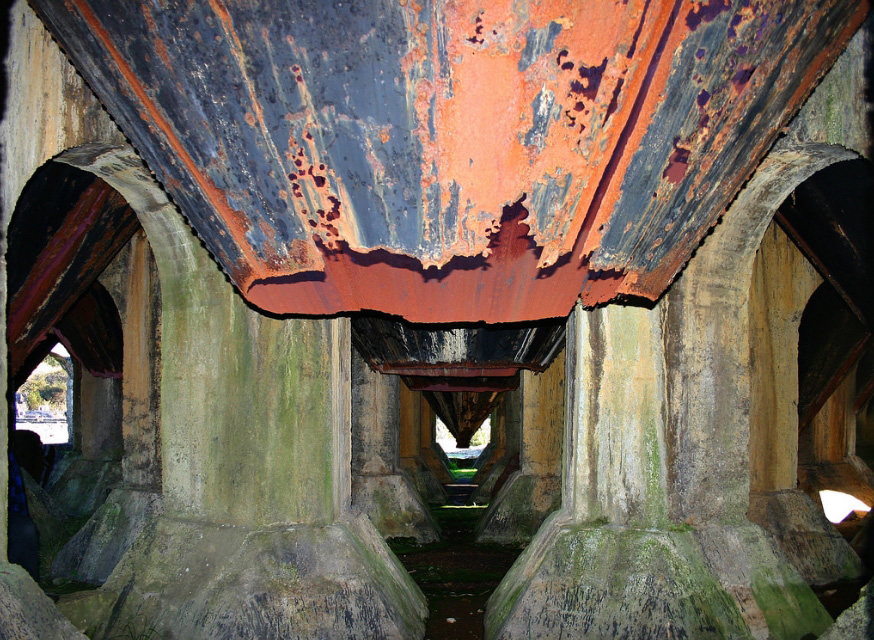
The local invention in 1902 of the Brown (or B and M) agitator tanks (known in some countries as Pachuca tanks), facilitated this increase in the extraction rate. The process involved cylindrical tanks in which the mix of pulverised ore and cyanide solution was agitated by charges of compressed air forced through the inverted conical bases. This air also provided a supply of - oxygen which further improved the extraction of the metals. The tanks which were built at the Victoria Battery between 1902 and 1910, were steel cylinders 4.5 metres in diameter and about 15.25 metres high which stood on the concrete holders or bases remaining at the site. Elsewhere tanks were made of wood or concrete. A spectacular set of concrete tanks survives at the Union Hill, Waihi.
List Entry Information
Status
Listed
List Entry Status
Historic Place Category 1
Access
Able to Visit
List Number
4678
Date Entered
28th June 1990
Date of Effect
28th June 1990
City/District Council
Hauraki District
Region
Waikato Region
Legal description
Sec 1 SO 59644 Blk XIV Ohinemuri SD Rec Res
Status
Listed
List Entry Status
Historic Place Category 1
Access
Able to Visit
List Number
4678
Date Entered
28th June 1990
Date of Effect
28th June 1990
City/District Council
Hauraki District
Region
Waikato Region
Legal description
Sec 1 SO 59644 Blk XIV Ohinemuri SD Rec Res
Why is this place significant?
Historic Significance
Historical Significance or Value This historic place was registered under the Historic Places Act 1980. This report includes the text from the original Building Classification Committee report considered by the NZHPT Board at the time of registration. The cyanide tank holders at the Victoria Battery site, Waikino, are a visible reminder of the successful field application of an improved method of extracting gold and silver from crushed ores. The method had been discovered in Scotland, but its industrial application was a local development. The holders and adjacent ruins indicate the large scale of the gold mining enterprise at Waihi and Karangahake.
Physical Significance
This historic place was registered under the Historic Places Act 1980. This report includes the text from the original Building Classification Committee report considered by the NZHPT Board at the time of registration. ARCHITECTURAL QUALITY: These cyanide tank holders make full use of the plastic qualities of poured concrete in the form of interlocking hexagonal elements. It achieves a compact industrial design, making effective use of the restricted space within the former industrial complex. This is a unique structure not repeated at other gold producing plants. TOWNSCAPE/LANDMARK VALUE: This remnant of industrial architecture is a prominent feature of the Ohinemuri River flat at the entrance to the Karangahake Gorge. It is clearly visible from State Highway 2.
Why is this place significant?
Historic Significance
Historical Significance or Value This historic place was registered under the Historic Places Act 1980. This report includes the text from the original Building Classification Committee report considered by the NZHPT Board at the time of registration. The cyanide tank holders at the Victoria Battery site, Waikino, are a visible reminder of the successful field application of an improved method of extracting gold and silver from crushed ores. The method had been discovered in Scotland, but its industrial application was a local development. The holders and adjacent ruins indicate the large scale of the gold mining enterprise at Waihi and Karangahake.
Physical Significance
This historic place was registered under the Historic Places Act 1980. This report includes the text from the original Building Classification Committee report considered by the NZHPT Board at the time of registration. ARCHITECTURAL QUALITY: These cyanide tank holders make full use of the plastic qualities of poured concrete in the form of interlocking hexagonal elements. It achieves a compact industrial design, making effective use of the restricted space within the former industrial complex. This is a unique structure not repeated at other gold producing plants. TOWNSCAPE/LANDMARK VALUE: This remnant of industrial architecture is a prominent feature of the Ohinemuri River flat at the entrance to the Karangahake Gorge. It is clearly visible from State Highway 2.
Construction Details
Start Year
1902
Finish Year
1910
Type
Original Construction
Description
Between 1902-1910
Construction Materials
Concrete
Notable Features
Its considerable visual appeal, from close-up
Construction Details
Start Year
1902
Finish Year
1910
Type
Original Construction
Description
Between 1902-1910
Construction Materials
Concrete
Notable Features
Its considerable visual appeal, from close-up
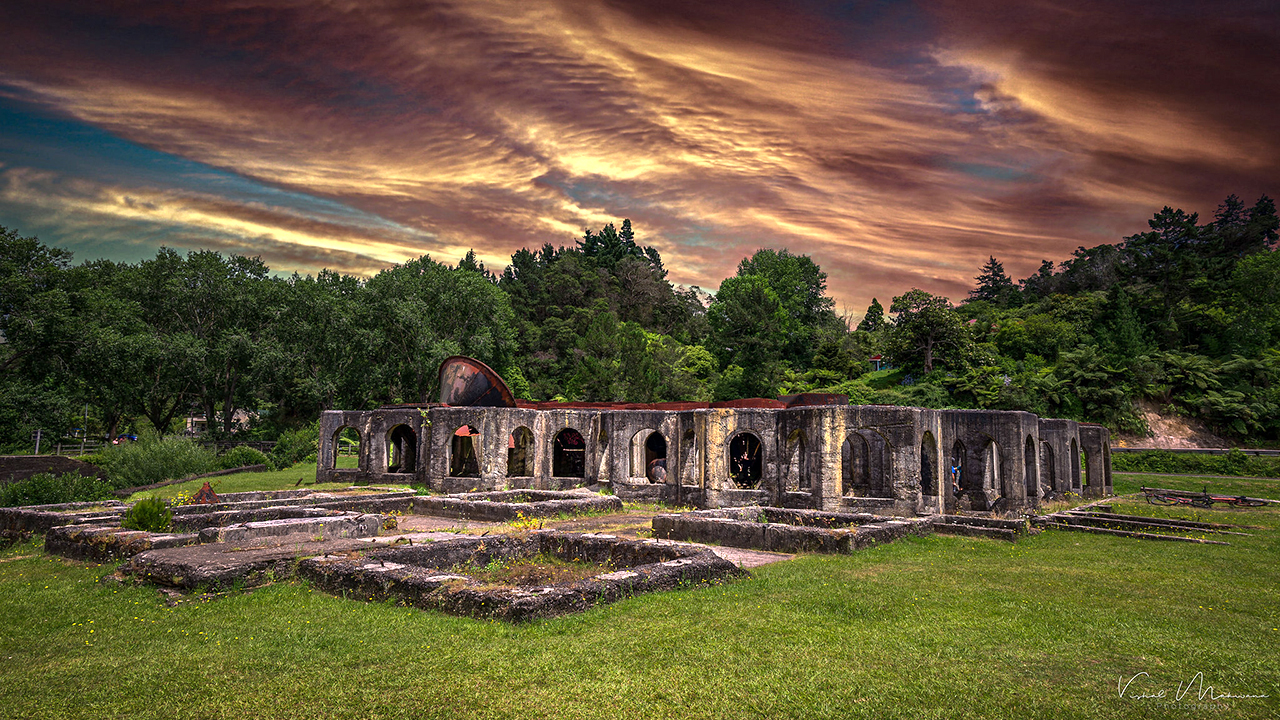
This historic place was registered under the Historic Places Act 1980. This report includes the text from the original Building Classification Committee report considered by the NZHPT Board at the time of registration. ARCHITECTURAL DESCRIPTION: The ruins consist of a number of hexagonal supports for the cylindrical cyanide tanks. Between the angles each vertical side has an arched opening. The whole complex is an integrated construction in concrete. In the top of each unit is a circular seating for the steel tanks. In many of these remain the inverted conical floors of the tanks through which the air which agitated the slimes and cyanide solution was forced. MODIFICATIONS: All superstructure and ancillary plant has been removed.
This historic place was registered under the Historic Places Act 1980. This report includes the text from the original Building Classification Committee report considered by the NZHPT Board at the time of registration. ARCHITECTURAL DESCRIPTION: The ruins consist of a number of hexagonal supports for the cylindrical cyanide tanks. Between the angles each vertical side has an arched opening. The whole complex is an integrated construction in concrete. In the top of each unit is a circular seating for the steel tanks. In many of these remain the inverted conical floors of the tanks through which the air which agitated the slimes and cyanide solution was forced. MODIFICATIONS: All superstructure and ancillary plant has been removed.
Historical and Associated Iwi / Hapū / Whānau
Completion Date
4th January 1990
Information Sources
McAra, J. B., 1988
J B McAra, Gold Mining at Waihi 1878-1952, Waihi, 1988
Thornton, 1982
Geoffrey G. Thornton, New Zealand's Industrial Heritage, A.H. & A.W. Reed, Wellington, 1982
Other Information
A copy of this report is available from the NZHPT Northern Region office Please note that entry on the New Zealand Heritage List/Rarangi Korero identifies only the heritage values of the property concerned, and should not be construed as advice on the state of the property, or as a comment of its soundness or safety, including in regard to earthquake risk, safety in the event of fire, or insanitary conditions. This historic place was registered under the Historic Places Act 1980. This report includes the text from the original Building Classification Committee report considered by the NZHPT Board at the time of registration. This historic place was registered under the Historic Places Act 1980. This report includes the text from the original Building Classification Committee report considered by the NZHPT Board at the time of registration.
Historical and Associated Iwi / Hapū / Whānau
Completion Date
4th January 1990
Information Sources
McAra, J. B., 1988
J B McAra, Gold Mining at Waihi 1878-1952, Waihi, 1988
Thornton, 1982
Geoffrey G. Thornton, New Zealand's Industrial Heritage, A.H. & A.W. Reed, Wellington, 1982
Other Information
A copy of this report is available from the NZHPT Northern Region office Please note that entry on the New Zealand Heritage List/Rarangi Korero identifies only the heritage values of the property concerned, and should not be construed as advice on the state of the property, or as a comment of its soundness or safety, including in regard to earthquake risk, safety in the event of fire, or insanitary conditions. This historic place was registered under the Historic Places Act 1980. This report includes the text from the original Building Classification Committee report considered by the NZHPT Board at the time of registration. This historic place was registered under the Historic Places Act 1980. This report includes the text from the original Building Classification Committee report considered by the NZHPT Board at the time of registration.
Current Usages
Uses: Civic Facilities
Specific Usage: Historic or recreation reserve
Web Links
description: Engineering NZ Heritage
url: https://www.engineeringnz.org/our-work/heritage/heritage-records/victoria-battery/
Current Usages
Uses: Civic Facilities
Specific Usage: Historic or recreation reserve
Web Links
description: Engineering NZ Heritage
url: https://www.engineeringnz.org/our-work/heritage/heritage-records/victoria-battery/